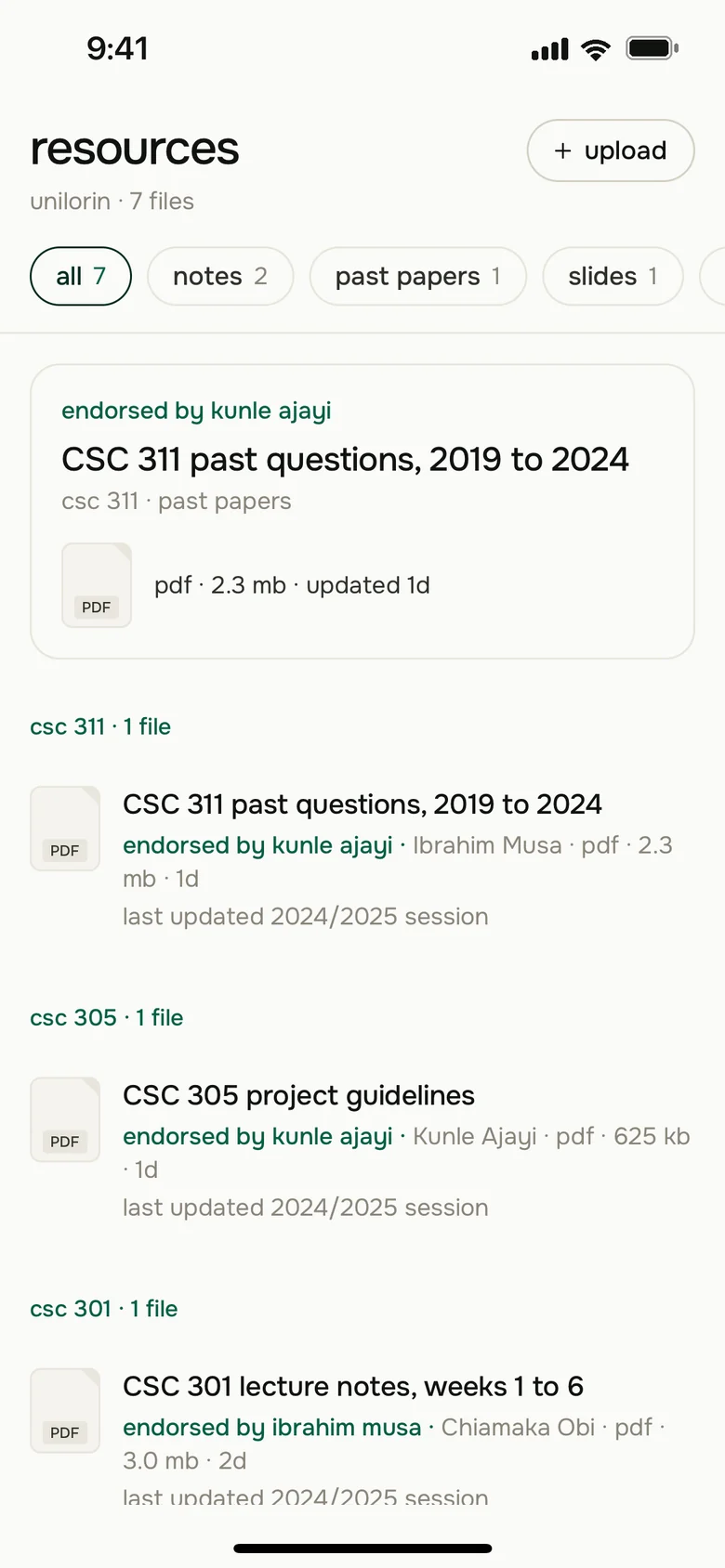
Most undergraduate projects in Nigerian universities follow the same five-chapter structure. Departments change the details, so your departmental project guide wins over anything here. If your department hasn't given you one, ask the project coordinator, and look at two or three recent projects your supervisor approved.
This is the outline most departments use, with notes on what each part is for.
The preliminary pages
These come before chapter one and are numbered in roman numerals (i, ii, iii).
- Title page. The full topic, your name, matric number, department and the month and year of submission, laid out exactly as your department wants.
- Certification or approval page. Where your supervisor and head of department sign.
- Dedication and acknowledgements. Keep them short.
- Abstract. One paragraph, usually 200 to 300 words, covering what you studied, how, what you found and what you recommend. Write it last.
- Table of contents, then lists of tables and figures if you have them.
Chapter one: introduction
Chapter one tells the reader what the problem is and what you're going to do about it.
Background to the study. Start from the general area and narrow down to your exact problem. Two to four pages is typical. Cite sources as you go.
Statement of the problem. The most important section in the chapter, and the one supervisors read most closely. Say what is wrong or missing, who it affects, and why existing work hasn't solved it. Keep it to a page.
Aim and objectives. One aim, then three to five specific objectives. Each objective should be something you can check at the end, so start them with verbs like "to determine", "to identify", "to design" or "to evaluate".
Research questions or hypotheses. Usually one question per objective. Survey-based projects in the social sciences and education often state null hypotheses as well.
Significance of the study. Who benefits from your findings and how. Name them: students, a ministry, small business owners, future researchers.
Scope and limitations. Scope is what you're covering: which people, which place, which period. Limitations are the honest constraints, like time, funding or access to data.
Definition of terms. The key words in your topic, defined the way you're using them.
Chapter two: literature review
Chapter two shows that you know what has already been written on your topic.
Many departments split it into three parts. The conceptual review explains the main ideas in your topic. The theoretical framework picks one or two theories and shows how they apply to your study. The empirical review summarises past studies like yours: who did them, what they did, what they found.
The common mistake is listing studies one after another without connecting them. After a group of studies, say what they have in common and where they leave a gap. End the chapter with that gap, because it's the reason your study exists.
Use recent sources where you can. A review made mostly of material more than fifteen years old gets questioned at the defence.
Chapter three: methodology
Chapter three explains how you did the study, in enough detail that someone else could repeat it.
For a survey or experimental project, it usually covers:
- Research design. Descriptive survey, experimental, case study and so on.
- Population. Everyone your study is about.
- Sample and sampling technique. How many people you actually studied and how you picked them. If you used a formula such as Taro Yamane's to get your sample size, show the working.
- Research instrument. Usually a questionnaire or interview guide. Put the full questionnaire in the appendix.
- Validity and reliability. How you made sure the instrument measures what it should, often a pilot test and a reliability coefficient.
- Method of data collection and analysis. How you gathered responses and which statistical tools you used, such as percentages, mean, chi-square or regression.
If you're building a system
Computer science and engineering projects usually replace most of this with system analysis and design. Describe the existing system and its problems, then the proposed system. Include your diagrams: use case, flowchart, entity relationship or data flow, whichever your department expects. Say which language, framework and database you chose, and why.
Chapter four: results
For a survey project, chapter four is data presentation, analysis and discussion. Present the responses in tables, then interpret each one in plain words. Test your hypotheses here and say whether each is accepted or rejected. Then discuss the findings against the studies from chapter two. Do they agree or not, and why might that be?
For a system you built, chapter four is usually implementation and testing. Show the main screens with short explanations, describe how you tested the system, and report the results. Include the system requirements needed to run it.
The common mistake in either case is putting tables in without explaining them. Every table needs a paragraph after it saying what it shows.
Chapter five: summary, conclusion and recommendations
Summary. A short recap of the whole project, chapter by chapter, with the main findings.
Conclusion. What your findings mean. Answer your research questions directly.
Recommendations. Practical suggestions that follow from what you found, each one pointed at someone who can act on it. Add suggestions for further study: what the next student could research to build on your work.
Don't bring in new findings or new sources here.
References and appendices
Most departments use APA style. Check which edition yours expects and be consistent. Every source cited in the text must be in the reference list, and every entry in the list must be cited somewhere in the text. Supervisors and external examiners check this.
Appendices hold the material that supports the work but would interrupt it: the questionnaire, the introduction letter, raw data, and for software projects, the source code or a link to it.
Where students lose marks
Supervisors and examiners pick on the same things every year. A statement of the problem that is really a second background. Objectives that don't match the research questions. A literature review with no gap at the end. Tables with no interpretation. Recommendations that have nothing to do with the findings. And references that don't match the citations.
If you're still at the topic stage, start with how to choose a final year project topic.