Every student collects past questions before exams. Fewer students use them well. The usual approach is to read through the questions, look at someone's answers, and hope the same ones come out. Sometimes they do, but a lecturer who notices the same paper being answered word for word tends to change it.
Used properly, past questions tell you much more than last year's answers. They show how your lecturer thinks, which topics they care about, and how much you can actually write in the time you'll have.
Get more than one year
One paper tells you very little. Three to five years tells you a lot. With several years side by side, you can see which questions come back, which topics show up every year, and whether the format has changed.
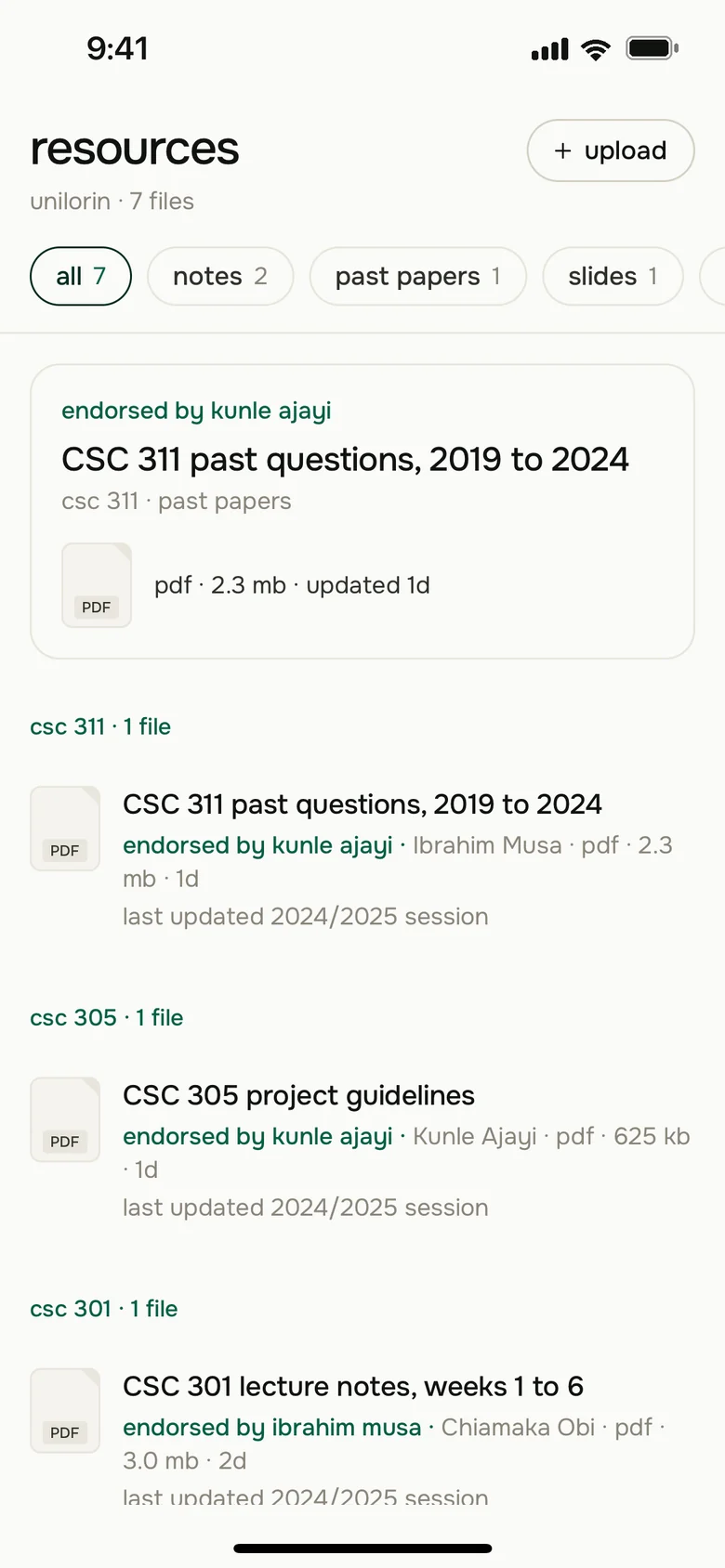
Ask the students a level ahead of you, check your department's resource room if it has one, and look in your department's space on Huddle, where students upload past questions by course code.
Check who set each paper if you can. If the course changed lecturers two years ago, the older papers matter less.
Sort the questions by topic
This is the step most people skip, and it's the most useful one.
Take your course outline and list its topics down the side of a page. Then go through every past paper and mark which topic each question comes from. After four or five years, you'll have something like this:
- Topic 3 appeared in every paper, usually as a long question.
- Topic 5 came out three times, always as a short calculation.
- Topic 7 hasn't appeared once.
Now you know where to spend your time. That doesn't mean you skip topic 7 entirely. It means you don't give it the same hours as topic 3.
Read the questions before you read the notes
Look at the questions on a topic before you study it. You'll read your notes differently when you know what you're going to be asked. Instead of trying to remember everything, you'll be looking for the parts that answer "explain", "compare", "calculate" or "with the aid of a diagram, describe".
Notice the verbs. A lecturer who asks you to "list" wants points. One who asks you to "discuss" wants paragraphs with reasons. Answering the wrong way costs marks even when the content is right.
Answer them yourself, without the solution
Reading a worked answer feels like learning, but it's mostly recognition. You know it when you see it, which isn't the same as producing it in the exam hall.
Close the solution and try the question yourself first. Write the full answer, not a few keywords in your head. Then check it against your notes or a solution you trust. The questions you couldn't answer are your revision list.
Be careful with answers that come with past questions. They are usually written by students and are sometimes wrong. If an answer doesn't match your notes, trust your notes and ask your lecturer or course rep.
Time yourself at least once
A week or two before the exam, take one full past paper and do it in the real time, with no phone and no notes. Most students find they write slower than they thought, or spend too long on the first question.
It also tells you how much to write. If the paper says answer four questions in two hours, that's thirty minutes each, including reading time. Practise writing an answer that fits in that.
Work through them with other people
Past questions are good for study groups because everyone can take a question, answer it, and explain it to the others. Explaining a solution out loud is one of the quickest ways to find out you don't actually understand it.
Keep the group small, three to five people, and agree on which paper you're doing before you meet.
What past questions can't do
They show you the pattern, but they don't replace the course. Lecturers add topics, change emphasis and sometimes set a completely new style of paper. Use past questions to decide how to study and what to practise, and still cover the whole outline.
If your course has a test or continuous assessment, the test questions are often a good preview of the exam. Keep your marked scripts.